
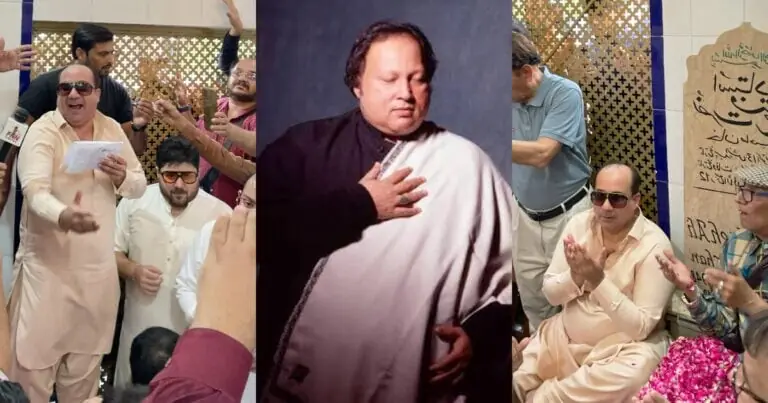
The hallowed grounds of a legend’s resting place are typically sites of quiet reverence, pilgrimage, and spiritual reflection. However, a recent performance by the acclaimed qawwali maestro, Rahat Fateh Ali Khan, at the Mazar (shrine) of his iconic uncle, Nusrat Fateh Ali Khan (NFAK), has stirred a significant wave of criticism and ignited a passionate debate across social media and cultural circles.
The incident, which saw Rahat Fateh Ali Khan deliver a performance at the very tomb of the late qawwali giant, has been met with widespread disapproval. Critics argue that while the intention might have been to pay homage, the act itself crossed a line, transforming a sacred space into a stage for a public spectacle. The Mazar of Nusrat Fateh Ali Khan is not merely a grave; it is a spiritual sanctuary, a place where devotees and admirers come to connect with the legacy and spiritual essence of a man who transcended musical boundaries and touched millions with his soulful voice.
The core of the criticism revolves around the perceived lack of sanctity and the commercialization of a deeply personal and spiritual space. Many believe that such a performance, particularly one that might be seen as a public event rather than a private, solemn offering, disrespects the sanctity of the shrine and the memory of the legendary artist. Nusrat Fateh Ali Khan’s qawwali was often a conduit for spiritual enlightenment, performed in traditional settings that emphasized devotion and humility. To some, a public performance at his Mazar, especially by a figure of Rahat’s stature, blurs the lines between artistic tribute and an inappropriate display.
This controversy also highlights a broader cultural tension: the evolving role of traditional art forms and their presentation in modern times. While Rahat Fateh Ali Khan is undoubtedly a torchbearer of the qawwali tradition, inheriting the mantle from his illustrious uncle, the manner in which this legacy is honored remains a point of contention. Is a public performance at a shrine a fitting tribute, or does it inadvertently diminish the spiritual gravitas of the location and the art form itself?
The debate underscores the deep emotional and cultural attachment people have to their spiritual sites and artistic heroes. For many, the Mazar of Nusrat Fateh Ali Khan is a place of profound respect and quiet contemplation, where his voice still echoes in the hearts of his followers. The recent performance has forced a crucial conversation about how to balance artistic expression, public accessibility, and the inviolable sanctity of sacred spaces, ensuring that the legacy of a legend is honored with the reverence it truly deserves.